
Modal Fabric Explained: Why It Beats Cotton in 90°F Heat
Modal is the fabric quietly outperforming cotton in every summer wardrobe — and most people wearing it couldn't name it. It shows up in tops, loungewear sets, and activewear under vague labels like "microfiber" or "soft jersey." That's a problem, because once you know what modal actually is, you can shop for it on purpose — and stop buying cotton tanks that go stiff and scratchy by August.
What modal fabric actually is
Modal is a type of rayon — a semi-synthetic fiber made by dissolving beech tree cellulose into a viscose solution, then extruding it through spinnerets into fine filaments. The result is a fiber that behaves more like a natural material than a synthetic one, but with tighter, more consistent structure than standard viscose rayon.
The dominant producer is Lenzing AG, an Austrian company that trademarked the process. Their branded version — TENCEL™ Modal — is the one you'll see cited in sustainability discussions. Generic modal exists too, made by other manufacturers with varying environmental controls. The fiber itself is the same; the production standards differ.
Beech trees are the key. They grow without irrigation in European forests, which keeps the water footprint low. The trees are also fast-growing and require no pesticides in managed forestry. Beech-based modal uses roughly 10–20 times less water per kilogram than conventional cotton (Lenzing AG, 2023 Fiber Report). That number varies by manufacturer and region, but the directional advantage over cotton is consistent across independent audits.
The fiber is spun into yarn and then knit or woven into fabric. Most modal you'll encounter is a jersey knit — smooth, slightly shiny face, matte back, with a four-way stretch that doesn't require spandex to achieve.
Modal vs. cotton in heat: the real difference
Cotton absorbs moisture well — up to 27 times its weight in water. The problem is it holds onto that moisture. In 90°F heat, a cotton shirt saturated with sweat takes 45–60 minutes to dry against your skin. It gets heavier, colder in air conditioning, and starts to smell faster because bacteria thrive in the sustained damp environment.
Modal absorbs about 50% more moisture than cotton by weight, but releases it faster. The fiber structure is smoother and less porous than cotton at the microscopic level, which means sweat wicks to the fabric surface and evaporates rather than pooling in the weave. The practical result: a modal top feels dry again within 15–20 minutes of peak sweat. A cotton top in the same conditions doesn't.
There's a texture difference too. Cotton fibers have a natural twist and irregularity — that's what gives cotton its matte, slightly rough hand. Modal filaments are extruded under controlled conditions, so they're uniform and smooth. Against bare skin in heat, modal feels cooler on contact. It's not a dramatic effect, but it's real and consistent.
"I always tell clients to think of modal as cotton that went to finishing school. Same natural-fiber feel, but better manners in heat and humidity. It doesn't wrinkle on a flight, it doesn't shrink in the wash, and it doesn't go stiff after three summers."
— Lena Park, Care & Materials Editor, Livostyle
One place cotton still wins: heavy-duty durability. A thick 12oz cotton canvas or a sturdy cotton twill will outlast modal in friction-heavy applications — workwear, denim, structured bags. For soft, body-skimming tops and loungewear, modal holds its shape better across repeated washes. Cotton pilling is also more aggressive; modal pills less because the filaments are smoother and more tightly bound.
Modal vs. Tencel: not the same thing
Both modal and Tencel (lyocell) come from wood pulp and are made by Lenzing AG. They are not interchangeable.
The production process is the key difference. Tencel lyocell uses a closed-loop solvent system — the chemical solvent is recovered and reused at a rate of over 99% (Lenzing AG). Modal uses a wet-spinning process that recovers less solvent. Both are cleaner than standard viscose rayon, but Tencel is cleaner than modal on the production side.
The fabric hand is different too. Tencel has a slightly crisper, more structured drape — it's the reason it works well in midi dresses and tailored pieces. Modal is softer and more elastic, which is why it dominates in tank tops, fitted sets, and anything worn close to the body for long stretches.
If you see "TENCEL™ Modal" on a label, that's Lenzing's certified version of modal fiber, not lyocell. The naming is confusing. "TENCEL™ Lyocell" is the lyocell product. Both use the TENCEL brand; neither is the other.
What modal feels like to wear
Smooth, cool, and light. The weight range for most modal jersey tops is 120–160 gsm (grams per square meter) — lighter than a standard cotton t-shirt at 160–200 gsm, and significantly lighter than a cotton-poly blend fleece. At 130 gsm, a modal tank drapes close to the body without clinging aggressively, and moves with you rather than pulling.
The stretch is real but not elastic. Modal jersey typically stretches 30–40% without spandex, and recovers well as long as you don't machine-dry it repeatedly at high heat (more on that in the care section). Add 5% spandex — common in activewear modal blends — and you get full four-way stretch with strong recovery.
One thing to know: modal shows sweat marks more visibly than a textured cotton because the smooth surface doesn't scatter light. A heather or print pattern hides this better than a solid. If you run warm and wear solid-color modal tops, go darker or go textured.
Where modal shows up in tops and sets
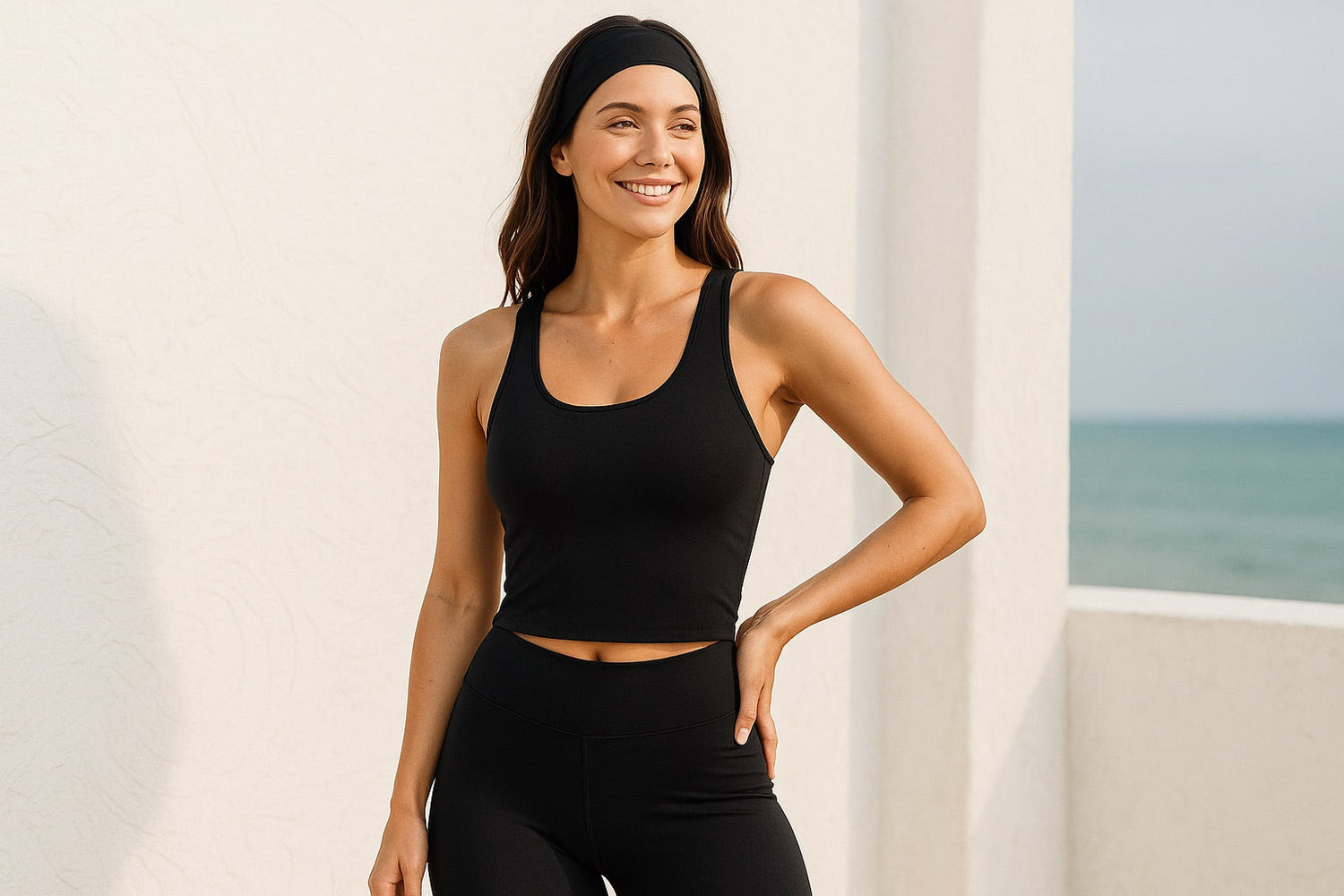
Modal is most common in three categories: fitted tanks, soft lounge sets, and activewear. It's the default fabric for anything described as "microfiber" in the loungewear space, and it shows up in activewear blended with spandex.
The inventory we carry leans toward soft sets and active-adjacent tops — pieces that live between the gym and the couch, or between the couch and a casual errand. Modal handles that middle zone better than cotton because it looks polished even when it's relaxed.
A few specific pieces worth knowing about:
- Round Neck Racerback Active Tank in Dusty Blue — a ribbed tank in the activewear category. Ribbed modal construction holds its shape under a bag strap and recovers after a workout. The dusty blue reads casual enough for errands.
- Bright Palette Scoop Neck Active Tank — ribbed scoop neck, sleeveless. The ribbed texture adds visual structure without adding weight. Works under a blazer for an office-casual look or alone at the gym.
- Light Rose Sweater Boxy Top and Long Pants Set — a mock-neck ribbed set in light rose. The boxy cut is deliberate; it doesn't pull across the shoulders the way a fitted modal top can if you size down.
- Microfiber Round Neck Top and Leggings Set in LT Navy — "microfiber" here is the category tell for modal-blend fabric. Long sleeve top with matching leggings. The navy colorway hides the sweat-visibility issue mentioned above.
If you're shopping two-piece sets for summer and you see "microfiber" or "scuba" in the product description, you're almost certainly looking at a modal or modal-blend fabric. Scuba is a double-knit modal construction — slightly thicker, more structured, with excellent wrinkle resistance.
How to care for modal so it lasts
Modal is forgiving compared to silk or dry-clean-only fabrics, but it has one real enemy: high heat. The fiber structure that makes it smooth and soft is also what makes it vulnerable to heat distortion.
- Wash cold. 30°C (86°F) maximum. Hot water causes the fibers to contract unevenly and can cause pilling along seams. Cold wash is fine for removing sweat and light soil.
- Tumble dry low or hang dry. High heat is the fastest way to degrade modal. A single high-heat dry cycle won't destroy a modal top, but ten of them will. Hang dry when possible — modal dries in under two hours at room temperature.
- Don't wring. Modal holds water in a way that makes wringing tempting, but twisting the fabric stresses the knit structure. Press out excess water between two towels instead.
- Iron on low if needed. Modal wrinkles less than cotton or linen, but if you need to press it, use a low-heat iron with steam on the reverse side. Direct high heat will create a sheen mark on the face of the fabric.
- Wash inside out. The face of modal fabric is the smooth, slightly shiny side. Washing inside out reduces friction against that surface and extends the life of the finish.
One more thing: modal is susceptible to snags from rough surfaces. Velcro, rough jewelry clasps, and laundry bags with zippers are the main culprits. A mesh laundry bag is the easiest preventive measure.
Modal and sustainability: the honest picture
Modal is better than conventional cotton on water use and better than polyester on biodegradability. It's not a perfect fiber.
The wood pulp sourcing is the main variable. Lenzing's TENCEL™ Modal uses FSC-certified beech forests in Austria and neighboring countries — the supply chain is short and audited. Generic modal from other manufacturers may source pulp from less-controlled forestry, including in regions where deforestation is a documented risk. The Canopy Style initiative tracks this and publishes an annual "Hot Button" report on dissolving pulp sourcing; it's worth checking if provenance matters to you.
Biodegradability is real but conditional. Modal biodegrades in industrial composting conditions — not in a standard landfill. The timeline in a landfill is meaningfully shorter than polyester (which essentially doesn't biodegrade), but it's not the same as a cotton t-shirt composting in your backyard.
The net position: for summer tops and activewear, modal is a better choice than polyester on environmental grounds and a better choice than cotton on performance grounds. It's not a sustainability solution on its own — buying fewer, better-cared-for pieces in any fiber matters more than fiber choice alone.
Frequently asked questions
Is modal fabric good for hot weather?
Yes. Modal absorbs 50% more moisture than cotton and releases it faster, which keeps it from clinging when you sweat. In temperatures above 85°F, it outperforms cotton for comfort because it dries against the skin rather than staying damp. The smooth fiber surface also feels cooler on contact than cotton's rougher texture.
Does modal shrink in the wash?
Modal is significantly more shrink-resistant than cotton. Washed cold and dried on low heat or air-dried, a modal top should hold its size across 50+ washes. The risk comes from high-heat drying — repeated high-heat cycles will cause gradual shrinkage and fiber degradation. Cold wash, low or no heat dry.
Is modal the same as rayon?
Modal is a type of rayon — specifically a high-wet-modulus rayon made from beech tree pulp. Standard viscose rayon is made from a broader range of wood pulps and uses a less controlled process. Modal is stronger when wet, more shrink-resistant, and softer than standard viscose. They're related but not interchangeable on a care label.
How do I know if a top is modal without checking the label?
Look for these tells: described as "microfiber," "super soft," or "scuba" fabric. Has a slight sheen on the face side. Stretches without spandex. Feels lighter than it looks. Dries quickly. If the care label says "machine wash cold, tumble dry low" and the fabric feels smooth and silky without being slippery like polyester, it's almost certainly a modal or modal-blend.
Can modal fabric be worn for workouts?
Yes, especially modal-spandex blends. Pure modal jersey (no spandex) has enough stretch for low-impact activity — yoga, walking, light gym work. For high-intensity training where you need strong shape recovery and compression, look for a modal blend with at least 5–8% spandex. The activewear category carries several options in ribbed modal construction that hold up through a full workout.